
Most people don’t think about television.
They turn it on.
They choose a channel.
They watch a movie.
And that’s the end of it.
In fact, if you’re under the age of 30, there’s a good chance you’ve never even stopped to ask yourself:
“How does television actually reach my screen?”
Strangely enough, most people know more about how their smartphone works than how their television works.
And that’s interesting.
Because television has been one of the most important technologies in modern history.
For decades, the way people watched TV remained almost unchanged.
You paid a cable company.
A technician showed up.
Wires were installed.
You received a bulky cable box.
And every month, the bill arrived like clockwork.
People accepted this system because they had no alternative.
If you wanted television, cable was television.
Simple.
Or at least it seemed simple.
But something interesting happened over the past two decades.
The internet became faster.
Much faster.
In the year 2000, the average broadband speed in the United States was measured in kilobits per second.
Today, many households have internet connections capable of delivering hundreds of megabits per second.
Some even have gigabit internet.
To put that into perspective:
Downloading a movie that once required several hours can now take only a few minutes.
This increase in internet speed changed everything.
Not just television.
Everything.
Music changed.
Movies changed.
Gaming changed.
Communication changed.
Shopping changed.
And eventually…
Television changed too.
That change is called IPTV.
And whether you realize it or not, IPTV has completely transformed the way millions of people consume entertainment.
In this guide, I’m going to explain exactly what IPTV is, how it works, why it’s becoming so popular, and why many people believe it represents the future of television.
Let’s begin.
What Is IPTV?
IPTV stands for:
Internet Protocol Television.
Sounds complicated?
It’s actually very simple.
Traditional television delivers content through:
- Cable networks
- Satellite signals
- Broadcast towers
IPTV delivers television through:
The internet.
That’s it.
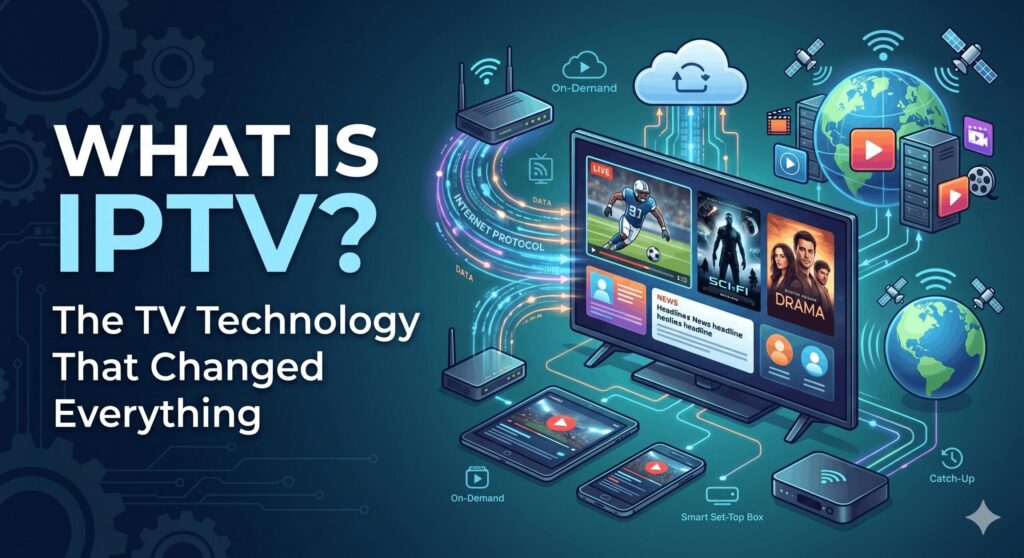
Instead of receiving TV channels through a satellite dish attached to your house or a cable line running through your wall, IPTV sends television content using the same internet connection you use every day.
The same internet connection you use for:
- YouTube
- Netflix
- Online gaming
Now delivers television as well.
Think about that for a moment.
For decades, television required its own dedicated infrastructure.
Its own cables.
Its own equipment.
Its own delivery systems.
IPTV eliminated much of that complexity.
Today, a small streaming device connected to your television can access thousands of channels from around the world using nothing more than an internet connection.
Twenty years ago, that would have sounded like science fiction.
Today, it’s completely normal.
Why Is It Called “Internet Protocol Television”?
You’re probably wondering:
“What does Internet Protocol actually mean?”
Good question.
Internet Protocol (IP) is simply the language devices use to communicate over the internet.
Every time you:
- Visit a website
- Watch a YouTube video
- Send an email
- Stream a movie
Your device is exchanging information using Internet Protocol.
IPTV uses the same principle.
Instead of sending emails or web pages, it sends television content.
The result?
Television becomes data.
And once television becomes data, it can be delivered in ways that were impossible with traditional broadcasting.
This is where things start getting really interesting.
The Problem With Traditional Television
Most people think IPTV became popular because it’s cheaper.
And while cost certainly played a role…
I don’t think that’s the biggest reason.
The biggest reason is flexibility.
Let me explain.
Imagine it’s 2005.
You subscribe to cable television.
Your provider offers:
- 300 channels
- Monthly contract
- Installation appointment
- Cable box rental
Sounds familiar?
Now imagine you want to watch:
- A soccer match from another country
- A niche documentary channel
- International news
- Foreign language programming
Good luck.
Traditional television was designed around geographic limitations.
Your location determined what content you could access.
This made sense decades ago.
But then the internet arrived.
And suddenly geography mattered less.
A person sitting in New York could watch content from London.
Someone in Toronto could watch channels from Paris.
Someone in Dubai could watch content from the United States.
The internet removed barriers that traditional television had spent decades creating.
This shift fundamentally changed consumer expectations.
People no longer wanted television companies deciding what they could watch.
They wanted choices.
And IPTV gave them those choices.
The Day Television Stopped Being Local
One of the most important moments in television history happened quietly.
Most people never noticed it.
For decades, television was local.
Your city determined your channels.
Your country determined your programming.
Your cable provider determined your options.
Today?
None of that is necessarily true.
A modern IPTV user can access:
- Local channels
- National channels
- International channels
- Sports networks
- Movie channels
- News channels
- Entertainment channels
All from a single interface.
This may sound normal to younger readers.
But historically, it’s revolutionary.
Television spent most of its existence being geographically restricted.
IPTV changed that.
And once consumers experienced unrestricted access, many had no desire to return to the old model.
How IPTV Actually Works
Now let’s answer the question most beginners ask.
“How does IPTV actually work?”
The process is surprisingly simple.
First, content is collected from various sources.
These sources may include:
- Television networks
- Sports broadcasters
- Entertainment providers
- Content distributors
That content is then processed and delivered through streaming servers.
When you open an IPTV player such as:
- IPTV Smarters Pro
- TiviMate
- Hot Player
- XCIPTV
Your device connects to those servers through the internet.
The content is then streamed directly to your screen.
Think of it like a restaurant.
Traditional television works like a buffet.
Everyone receives the same food at the same time.
IPTV works more like ordering from a menu.
You request specific content.
The server delivers that content.
This is one reason IPTV can offer far greater flexibility than traditional broadcasting methods.
Why IPTV Feels Different
Have you ever noticed something?
People who switch to IPTV often become surprisingly enthusiastic about it.
Why?
Because IPTV doesn’t just change how content is delivered.
It changes how people think about television.
Suddenly, viewers expect:
- More channels
- More flexibility
- More devices
- More content
- More control
And once people experience that level of control, they rarely want to go backwards.
Psychologists call this:
Expectation adaptation.
Once we become accustomed to greater convenience, our expectations permanently change.
The smartphone changed expectations.
Netflix changed expectations.
Amazon changed expectations.
And IPTV changed expectations for television.
Once viewers realize they can access content on:
- Firestick
- Android TV
- Smart TVs
- Apple TV
- Smartphones
- Tablets
- PCs
The traditional cable model starts to feel outdated.
And that’s exactly why IPTV continues growing year after year.
IPTV Growth By The Numbers
The numbers tell an interesting story.
Global IPTV adoption has increased dramatically over the past decade.
Industry analysts estimate that IPTV-related services now represent a market worth tens of billions of dollars globally.
Millions of households have already transitioned from traditional television systems toward internet-based streaming solutions.
Why?
Because the advantages are difficult to ignore:
- Greater flexibility
- More viewing options
- Better device compatibility
- Improved user experience
Consumers consistently move toward technologies that offer greater convenience.
History shows this repeatedly.
Physical media became streaming.
DVD rentals became Netflix.
Cable television gradually evolved into IPTV and internet-based viewing.
And the trend shows no signs of slowing down.
But Is IPTV Difficult To Use?
This is probably the biggest myth surrounding IPTV.
Many people assume IPTV is highly technical.
I understand why.
The terminology sounds intimidating:
- IPTV
- M3U URL
- Xtream Codes API
- EPG
- Playlist URL
At first glance, it seems complicated.
But here’s the truth.
Most IPTV users spend more time choosing what to watch than actually setting up IPTV.
Modern IPTV applications have become remarkably simple.
Many setups require nothing more than:
- Username
- Password
- Portal URL
Or a single M3U playlist link.
Once entered, the application does most of the work automatically.
In many cases, setup takes less than five minutes.
And that’s one of the reasons IPTV adoption continues growing among everyday users.
It no longer requires technical expertise.
It simply requires an internet connection and a compatible device.
IPTV vs Cable TV
I want you to do a quick mental exercise.
Imagine it’s 1998.
You want television.
You call a cable company.
You wait several days for an installation appointment.
A technician arrives.
He drills holes.
Runs cables.
Installs equipment.
Activates your service.
You pay your monthly bill.
And if you move houses?
You repeat the entire process again.
For decades, people accepted this system because there wasn’t much competition.
Cable television dominated the industry.
Consumers had very little leverage.
Very little flexibility.
Very few alternatives.
Then something happened.
The internet became powerful enough to deliver video.
And suddenly, the entire television industry faced a serious problem.
Consumers no longer needed dedicated television infrastructure.
They already had internet.
Why pay for two delivery systems when one could do everything?
That question changed the television industry forever.
The Biggest Difference
The biggest difference between IPTV and cable television isn’t necessarily channel count.
It’s freedom.
Cable television is built around infrastructure.
IPTV is built around connectivity.
With cable TV, your service depends on physical hardware.
With IPTV, your service depends primarily on internet access.
This creates several advantages.
Device Flexibility
Cable television typically revolves around a cable box.
IPTV can work on:
- Amazon Fire TV Stick
- Android TV
- Smart TVs
- Apple TV
- Smartphones
- Tablets
- Windows PCs
- Mac computers
This flexibility fundamentally changes the viewing experience.
You no longer have to watch television in one room.
Or on one device.
Or through one piece of hardware.
Television becomes portable.
Content Diversity
Traditional cable providers generally offer predefined packages.
You pay for bundles.
Whether you want those channels or not.
IPTV users often enjoy access to:
- Local channels
- National channels
- International channels
- Sports networks
- Movie channels
- Entertainment channels
From a single platform.
This broader selection is one reason IPTV has become increasingly popular among households with diverse viewing preferences.
Updates and Improvements
Cable systems tend to evolve slowly.
IPTV applications evolve quickly.
Features that were unavailable six months ago can suddenly appear through software updates.
Think about that.
Your television experience can improve without replacing hardware.
That wasn’t common during the cable television era.
IPTV vs Satellite TV
Satellite television solved some problems that cable couldn’t.
It allowed content delivery to remote locations.
Rural areas.
Mountain regions.
Places where cable infrastructure wasn’t practical.
For many years, satellite television represented a technological breakthrough.
But it came with its own challenges.
Weather Dependency
Most satellite users have experienced this.
A severe storm arrives.
Heavy rain.
Snow.
Strong winds.
Suddenly the signal becomes unreliable.
This phenomenon became so common that many satellite subscribers simply accepted it as normal.
IPTV doesn’t rely on satellites.
It relies on internet connectivity.
As long as your internet connection remains stable, weather generally has far less influence on viewing quality.
Installation Complexity
Satellite systems often require:
- Dish installation
- Alignment
- Mounting hardware
- Professional setup
IPTV typically requires:
- Internet connection
- Compatible device
- IPTV application
The difference in complexity is obvious.
Global Content Access
Historically, satellite services were often region-specific.
IPTV changed that.
Today, viewers can access content from multiple regions through a single platform.
And this is one of the biggest reasons IPTV appeals to multicultural households.
Many families watch content from multiple countries.
Traditional television wasn’t designed for that.
IPTV was.
The Three Types of Content Most IPTV Users Watch
When people first hear about IPTV, they usually imagine live television.
And that’s certainly part of the experience.
But modern IPTV offers much more than that.
Most IPTV usage falls into three categories.
1. Live Television
This is the traditional television experience.
Channels broadcast content in real time.
Examples include:
- News
- Sports
- Entertainment
- Local programming
Live television remains one of the biggest reasons people subscribe to IPTV services.
Especially sports fans.
Because sports are one of the few types of content people still prefer watching live.
Nobody wants to watch yesterday’s championship game when everyone already knows the score.
2. Video On Demand (VOD)
This category has exploded in popularity.
Video On Demand includes:
- Movies
- TV series
- Documentaries
- Kids content
In many households, VOD is now used more frequently than live television.
Think about your own viewing habits.
How often do you sit down and watch a television channel compared to selecting a specific movie or series?
Exactly.
Viewer behavior has changed dramatically.
People increasingly want control over what they watch and when they watch it.
VOD satisfies that desire.
3. Catch-Up and Replay Features
One of the most frustrating aspects of traditional television was missing a program.
You forgot to record it.
You missed the broadcast.
Too bad.
Modern IPTV systems often provide more flexibility.
Many viewers now expect features such as:
- Replay
- Catch-up viewing
- Time-shifted content
This reflects a larger trend in entertainment.
People increasingly consume content according to their schedules rather than broadcaster schedules.
Why Sports Fans Love IPTV
Sports deserve their own section.
Because sports are one of the biggest drivers behind IPTV adoption.
Think about how passionate sports fans can be.
A dedicated football fan might watch:
- League matches
- International tournaments
- Analysis shows
- Transfer news
- Highlight programs
Across multiple networks.
Traditional television often makes this expensive.
Or inconvenient.
Or both.
IPTV helps consolidate access to sports content.
And that’s one reason sports enthusiasts often become some of the most loyal IPTV users.
Sports Are Different
Movies can wait.
TV shows can wait.
Sports cannot.
Sports are live experiences.
And because of that, sports fans place enormous value on reliable live streaming.
This explains why sports categories consistently rank among the most viewed IPTV content worldwide.
What Is an IPTV Player?
This is another concept that confuses beginners.
People often think IPTV and IPTV players are the same thing.
They’re not.
An IPTV player is simply the software used to access IPTV content.
Think of it like this.
Netflix provides content.
The Netflix app displays that content.
Similarly:
An IPTV service provides content.
An IPTV player displays that content.
The player acts as the bridge between the viewer and the content.
Popular IPTV Players
Several applications have become extremely popular among IPTV users.
TiviMate
Many experienced users consider TiviMate one of the best IPTV players available.
Why?
Because it offers:
- Fast navigation
- Excellent EPG support
- Clean interface
- Powerful customization
IPTV Smarters Pro
One of the most beginner-friendly IPTV applications.
Popular because it’s:
- Easy to install
- Easy to configure
- Easy to understand
Hot Player
Known for simplicity and speed.
Many users appreciate its lightweight design.
XCIPTV
A modern IPTV player with strong usability features.
Each application has strengths.
And fortunately, users can choose whichever player best fits their preferences.
M3U URLs Explained
At some point, every IPTV user encounters the term:
M3U URL
And for beginners, it sounds terrifying.
I remember seeing it for the first time.
It looked like something only programmers would understand.
The reality?
It’s simply a playlist.
That’s all.
The M3U URL tells the IPTV application:
- Which channels exist
- Which categories exist
- Where content is located
The player then organizes everything into a user-friendly interface.
Think of the M3U URL as a map.
Without the map, the application doesn’t know where to go.
With the map, everything becomes organized.
Simple.
Xtream Codes Login Explained
Over the years, another login method became increasingly popular.
Xtream Codes API login.
This method typically uses:
- Username
- Password
- Portal URL
Instead of importing a playlist directly.
Many users prefer this method because it automates much of the setup process.
The application often imports:
- Live TV
- Movies
- TV Series
- EPG data
Automatically.
For beginners, this can make setup significantly easier.
And that’s one reason Xtream Codes login has become so widespread.
Why Millions Are Switching to IPTV
Now let’s talk about the bigger picture.
Why are so many people switching?
Because technology adoption follows predictable patterns.
People don’t adopt new technology simply because it’s new.
They adopt it because it solves problems.
IPTV solves several important problems.
Problem #1: Limited Choice
Consumers want options.
IPTV provides options.
Problem #2: Device Restrictions
Consumers want flexibility.
IPTV provides flexibility.
Problem #3: Geographic Limitations
Consumers want access.
IPTV provides access.
Problem #4: Convenience
Consumers want simplicity.
IPTV provides simplicity.
When a technology solves enough problems simultaneously, adoption accelerates.
That’s exactly what happened with IPTV.
And it’s exactly why the industry continues growing year after year.
A Personal Observation About Human Behavior
After years of studying technology adoption, I’ve noticed something interesting.
People rarely resist better experiences.
They resist change.
At first.
Then something happens.
They try the new technology.
They become familiar with it.
And eventually they wonder how they ever lived without it.
This happened with:
- Smartphones
- Streaming services
- Online shopping
- Social media
And it happened with IPTV.
Once viewers become accustomed to choosing what they want, when they want, on whichever device they want…
Traditional television starts feeling restrictive.
Not because traditional television became worse.
But because expectations changed.
And once expectations change, there is rarely any going back.
What Internet Speed Do You Need for IPTV?
One of the biggest misconceptions about IPTV is that you need an incredibly fast internet connection.
You don’t.
What you actually need is a stable connection.
There’s a huge difference.
I’ve seen people with 500 Mbps internet connections struggle with buffering because their network was unstable.
I’ve also seen people with much slower connections stream content perfectly because their network was reliable.
Most IPTV problems blamed on IPTV are actually network problems.
That surprises many people.
But it’s true.
Recommended Internet Speeds
While requirements vary depending on content quality, these are generally safe guidelines:
Notice something?
The requirements aren’t extreme.
Modern internet connections can easily handle these speeds.
The bigger challenge is consistency.
Why Stability Matters More Than Speed
Imagine driving a car.
Would you rather have:
- A car that constantly changes speed between 0 and 150 km/h?
Or:
- A car that maintains a steady 100 km/h?
Most people choose the second option.
Streaming works similarly.
Consistent delivery is often more important than peak performance.
This is why network quality matters.
Not just raw speed.
Common Causes of Buffering
Many people immediately blame IPTV when buffering occurs.
Sometimes they’re right.
But often they’re not.
Common causes include:
- Weak Wi-Fi signals
- Router congestion
- ISP routing issues
- Outdated devices
- Network interference
This is why experienced IPTV users frequently recommend:
- Wired Ethernet connections
- Quality routers
- Modern streaming devices
The better your network environment, the better your viewing experience.
What Devices Can Run IPTV?
One of IPTV’s greatest strengths is flexibility.
Traditional television often required specialized equipment.
IPTV doesn’t.
Today, IPTV can run on an enormous variety of devices.
Amazon Fire TV Stick
Probably the most popular IPTV device in the world.
Why?
Because it offers:
- Affordable pricing
- Easy setup
- Excellent app support
Many IPTV users start with a Firestick and never feel the need to upgrade.
Android TV
Android TV devices are extremely popular among advanced users.
Examples include:
- NVIDIA Shield TV
- Google TV
- Android TV boxes
These devices often provide greater customization options.
Smart TVs
Modern Smart TVs have become surprisingly capable.
Popular platforms include:
- Samsung Smart TV
- LG Smart TV
- Android Smart TV
Many users no longer need external hardware.
They simply install an IPTV application directly on their television.
Smartphones and Tablets
One of the biggest advantages of IPTV is portability.
You can watch content almost anywhere.
Examples include:
- Android phones
- iPhones
- iPads
- Android tablets
This flexibility would have seemed incredible during the cable television era.
Computers
Many users also enjoy IPTV on:
- Windows PCs
- Mac computers
Particularly when working from home or traveling.
The ability to move between devices is one of IPTV’s strongest advantages.
The Psychology Behind IPTV’s Popularity
Now I want to discuss something most IPTV articles completely ignore.
Psychology.
Because technology alone doesn’t explain IPTV’s success.
Human behavior does.
Humans Crave Control
Think about how entertainment worked twenty years ago.
Television networks controlled:
- What you watched
- When you watched it
- How you watched it
Consumers had limited control.
IPTV changed that.
Suddenly viewers could decide:
- Which device to use
- Which content to watch
- Which country to watch from
- Which player to install
Control shifted from broadcasters to consumers.
Humans love that.
In psychology, perceived control is strongly associated with satisfaction.
People enjoy experiences more when they feel in control.
This helps explain why IPTV feels different.
Humans Hate Restrictions
Imagine telling someone:
“You can only watch content in this room.”
Most people would immediately dislike the idea.
Restrictions create frustration.
IPTV removes many traditional restrictions.
You can watch content:
- On different devices
- In different rooms
- While traveling
- On multiple platforms
Freedom increases satisfaction.
And satisfaction drives adoption.
Humans Adapt Quickly
This is perhaps the most important factor of all.
People adapt.
Fast.
Once viewers experience:
- On-demand content
- Flexible viewing
- Device freedom
- Global channel access
Their expectations permanently change.
This phenomenon is called hedonic adaptation.
What once felt extraordinary eventually becomes normal.
And once something becomes normal, people rarely want to return to the old system.
This explains why many IPTV users never go back to traditional television.
Common IPTV Myths
Let’s address some myths.
Because there are plenty of them.
Myth #1: IPTV Is Too Complicated
Years ago, this may have been true.
Today?
Not really.
Modern IPTV applications are surprisingly beginner-friendly.
Many setups require only:
- Username
- Password
- Portal URL
Or an M3U playlist.
Most users can complete setup within minutes.
Myth #2: IPTV Requires Expensive Equipment
False.
Many people use affordable devices such as:
- Firestick
- Android TV boxes
- Smart TVs
You don’t need a home theater worth thousands of dollars.
Myth #3: IPTV Is Only for Tech Experts
Also false.
I’ve seen people with virtually no technical experience successfully set up IPTV.
Why?
Because software has improved dramatically.
The industry has become much more user-friendly.
Myth #4: IPTV Will Replace All Television
Probably not.
History rarely works that way.
New technologies usually coexist with older technologies.
Radio survived television.
Books survived the internet.
Cinema survived streaming.
Traditional television will likely continue existing.
But IPTV will continue growing alongside it.
What Does the Future of IPTV Look Like?
Predicting the future is difficult.
But some trends seem obvious.
Better Streaming Quality
Internet speeds continue improving globally.
This will support:
- More HD content
- More 4K content
- Better viewing experiences
Better Applications
IPTV software continues evolving.
Modern applications already offer features that would have seemed impossible a decade ago.
Expect even more improvements.
Greater Personalization
Consumers increasingly expect personalized experiences.
Future IPTV platforms will likely become even better at:
- Recommendations
- Content organization
- User preferences
Multi-Device Viewing
This trend is already happening.
People no longer think in terms of televisions.
They think in terms of screens.
And IPTV fits perfectly into that future.
Frequently Asked Questions
What Is IPTV?
IPTV stands for Internet Protocol Television.
It delivers television content through the internet rather than traditional cable or satellite systems.
How Does IPTV Work?
IPTV streams content through internet connections.
Users access content through IPTV players installed on compatible devices.
Is IPTV Better Than Cable TV?
It depends on your preferences.
Many users prefer IPTV because of:
- Flexibility
- Device compatibility
- Content variety
What Devices Support IPTV?
Popular IPTV devices include:
- Amazon Fire TV Stick
- Android TV
- Smart TVs
- Apple TV
- Smartphones
- Tablets
- Computers
What Is an IPTV Player?
An IPTV player is the software used to access IPTV content.
Examples include:
- IPTV Smarters Pro
- TiviMate
- Hot Player
- XCIPTV
What Is an M3U URL?
An M3U URL is a playlist link that contains information about channels and content available through an IPTV service.
What Is Xtream Codes Login?
Xtream Codes login uses:
- Username
- Password
- Portal URL
To connect IPTV applications to content servers.
Final Thoughts
Most people don’t realize they’re living through one of the biggest shifts in television history.
Because technological revolutions rarely announce themselves.
They happen quietly.
One person switches.
Then another.
Then a million more.
And before anyone notices, an entire industry has changed.
That’s exactly what happened with IPTV.
Television used to be defined by limitations.
Limited devices.
Limited locations.
Limited content.
Limited flexibility.
IPTV challenged those limitations.
And in doing so, it fundamentally changed what viewers expect from television.
Today, millions of people no longer ask:
“What channels does my television provider offer?”
Instead they ask:
“What do I want to watch?”
That’s a completely different mindset.
And it’s the reason IPTV continues growing around the world.
The technology itself is fascinating.
But what fascinates me even more is what it reveals about human behavior.
People don’t necessarily want more technology.
They want more freedom.
More convenience.
More control.
More choice.
IPTV happens to deliver all four.
And that’s why it became one of the most important television technologies of the modern era.
Not because it changed television.
But because it changed what people expect television to be.
Once that happens, there is rarely any going back.
Television changed.
The audience changed.
And IPTV was one of the technologies that made it happen.